Changing the Guard: How Women Are Redefining Leadership Across American Thoroughbred Racing
For much of thoroughbred racing's American history, the winner's circle was a place where women appeared primarily in a ceremonial capacity—presenting trophies, posing for photographs, celebrating alongside the men who trained and rode the horses. That image has not merely been updated in recent years. It has been fundamentally dismantled.
Today, women occupy positions of genuine authority and competitive distinction across every tier of the sport. They are riding in the Kentucky Derby. They are conditioning horses that win graded stakes on the sport's most prestigious stages. They are making decisions about racing dates, track operations, and industry policy at the executive level. The change has been neither sudden nor simple, but its momentum is now undeniable.
The Jockey's Stand: Competing at the Highest Level
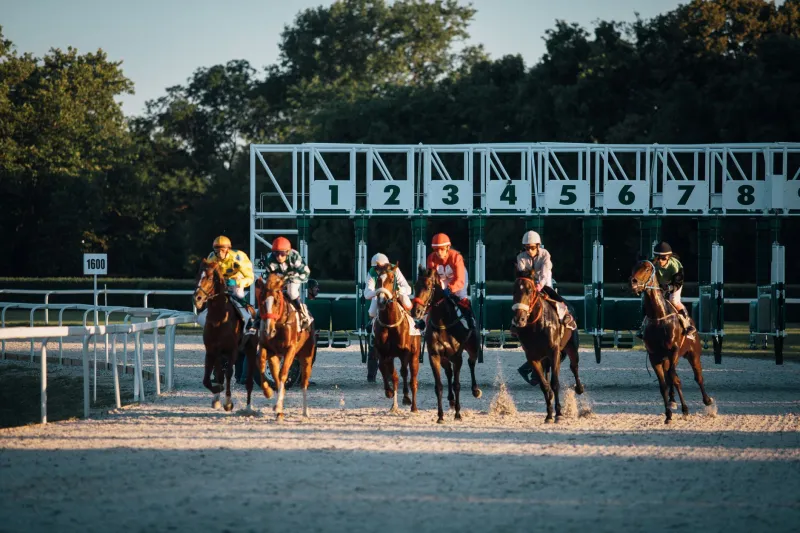
The cockpit of thoroughbred racing—the saddle—has historically been among the most resistant spaces to female participation. Physical demands, institutional skepticism, and cultural tradition combined to limit the presence of women riders at elite levels for decades after Diane Crump became the first female jockey to compete in the Kentucky Derby in 1970.
The current generation of female riders has changed that calculus decisively. Jockey Flavien Prat's circuit dominates headlines, but riders such as Rosie Napravnik—a five-time Eclipse Award winner before her retirement—demonstrated that women could compete at the very top of the sport, not as novelties but as genuine forces. Napravnik rode in three consecutive Kentucky Derbies between 2012 and 2014, finishing fifth in 2013 aboard Mylute in a performance that silenced lingering doubts about female riders in America's most famous race.
Among currently active riders, the pipeline of female talent continues to develop. Younger jockeys navigating the regional circuits from Remington Park in Oklahoma to Laurel Park in Maryland are building records that position them for major opportunities. The Jockeys' Guild has in recent years made deliberate efforts to support female riders through mentorship initiatives and advocacy for equitable mount opportunities—an acknowledgment that structural barriers, not ability, have historically limited women's representation in the saddle.
Training the Talent: Female Conditioners on the Major Circuits
Perhaps the most dramatic shift in American racing's gender dynamics has occurred in the training ranks. The trainer—the individual responsible for a horse's fitness, race placement, and day-to-day conditioning—wields enormous influence over outcomes on the track. The emergence of female trainers who compete and win at the highest levels represents a meaningful cultural shift in who is trusted with that responsibility.
Charlotte Weber, who has long been a prominent owner-breeder, and Linda Rice, who became one of New York's leading trainers by wins during her career, helped establish that women could succeed in the conditioning ranks. But it is the current generation—trainers such as Christiana Dominguez and others building their books at major facilities—who are normalizing female authority in the barn.
More broadly, the data tells a story of progress. The percentage of licensed female trainers in the United States has grown steadily over the past decade, and several now rank among the leading conditioners at their respective circuits by both wins and earnings. The stereotype of the trainer as an older male figure, weathered by decades on the backstretch, is giving way to a more diverse reality.
"There was a time when owners would call and ask to speak to the head trainer, and when I answered, there would be a pause," one female trainer told The Galloper. "That pause happens much less often now. The results speak for themselves."
Executive Leadership: Women at the Helm of Major Institutions
Beyond the track and the barn, women have assumed consequential leadership roles within the administrative and executive structures of American racing. This dimension of the sport's transformation is perhaps the least visible to the casual fan but carries the broadest implications for the sport's direction.
Nadine Limbocker's tenure in various leadership roles within the industry, along with figures such as Belinda Stronach—who led The Stronach Group's transformation of properties including Santa Anita Park and Gulfstream Park—demonstrated that women could shape the business of racing at the highest organizational level. The Stronach Group's operations, under female executive influence, pursued significant capital investments in track safety and modernization during a period when the industry faced intense scrutiny over horse welfare.
At the regulatory level, women have also made inroads. State racing commissions—the bodies that license participants, adjudicate claims, and enforce rules—have seen increased female representation, bringing perspectives that have informed policy discussions around medication reform, safety protocols, and industry transparency.
The Cultural Dimension: Modernizing a Traditional Sport
The presence of women in positions of authority is doing something beyond diversifying racing's workforce. It is actively modernizing the sport's culture in ways that have practical consequences for its future.
American thoroughbred racing faces genuine existential challenges: competition from expanded sports wagering markets, declining on-track attendance at many venues, and ongoing public concern about horse welfare and industry integrity. Addressing those challenges requires leadership willing to think differently about how the sport presents itself, who it serves, and what values it embodies.
Female leaders across racing have been disproportionately associated with initiatives focused on horse welfare reform, fan engagement innovation, and community outreach—areas where the sport has historically underperformed. Whether that correlation reflects individual priorities or something more structural is a matter of debate, but the outcomes have been broadly positive for the sport's public standing.
"Racing has always been a sport that rewards the best—the best horses, the best riders, the best trainers," said one female executive with ties to multiple major racing organizations. "When you open the door to the full range of talent, the sport gets better. It's that straightforward."
A Sport Still in Transition
Progress, to be clear, does not mean completion. Female jockeys still receive fewer mounts than their male counterparts at comparable career stages. Female trainers continue to encounter skepticism when approaching certain ownership groups. The backstretch culture, which sustains the daily labor of thoroughbred racing, remains in many respects a traditional environment where change arrives slowly.
But the trajectory is clear. The women who have entered this sport—in the irons, on the shedrow, in the boardroom—have done so with skill, tenacity, and an evident love for the thoroughbred. They have not merely joined racing's existing culture. They are, in meaningful ways, reshaping it.
At The Galloper, we will continue to follow their stories as the Sport of Kings evolves into something that reflects the full breadth of the people who love it.