Sold Abroad: The Quiet Exodus of American Thoroughbreds to Overseas Markets
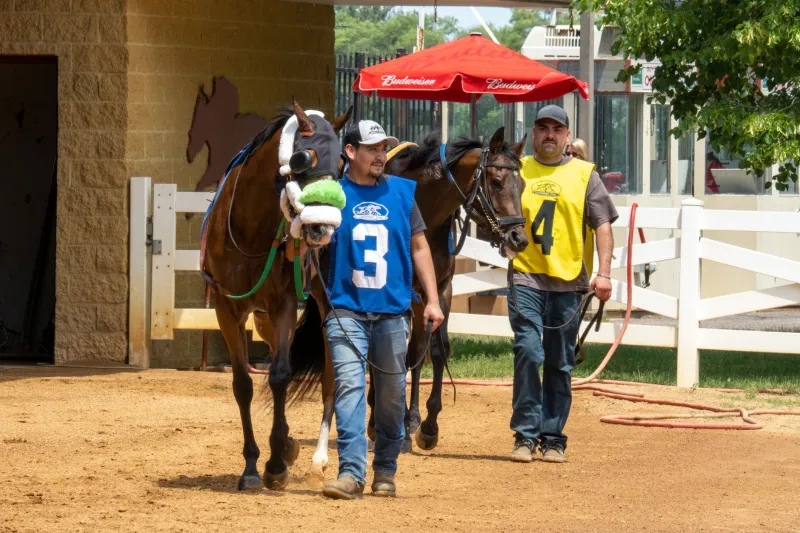
The Keeneland September Yearling Sale remains one of the great spectacles in global thoroughbred commerce — a week-long convergence of capital, pedigree, and ambition that draws buyers from every significant racing jurisdiction on earth. What has changed in recent years is not the composition of the crowd so much as the direction in which the horses leave. Increasingly, the most coveted lots at American sales are departing not for Churchill Downs or Saratoga, but for racecourses in Japan, the United Arab Emirates, Hong Kong, and Ireland.
This is not a development that has gone unnoticed within the American racing establishment, though the response has thus far been more diagnostic than corrective. The forces driving the outbound movement of elite horses are structural rather than incidental, rooted in prize money gaps, breeding program incentives, and a global market for equine talent that has grown more competitive with each passing decade.
The Prize Money Gap
The numbers, examined plainly, tell an uncomfortable story for American racing. The Dubai World Cup, run each spring at Meydan Racecourse, carries a purse of twelve million dollars — a figure that dwarfs every race on the American calendar with the exception of the Breeders' Cup Classic. The Japan Cup, contested at Tokyo Racecourse in November, offers a purse that regularly exceeds six million dollars to foreign participants under the most favorable conversion rates. The Longines Hong Kong Cup, the Irish Champion Stakes, and the Prix de l'Arc de Triomphe each represent financial opportunities that American racing has struggled to match.
By contrast, the Kentucky Derby's purse, while substantial by historical standards, has not kept pace with the escalation of international prize money. The Preakness and Belmont Stakes have faced well-documented financial pressures tied to their host tracks' commercial challenges. Outside the Triple Crown and the Breeders' Cup, the American stakes schedule offers relatively few races capable of generating the kind of single-day financial return that elite international fixtures routinely provide.
For an owner managing a horse of genuine Group One caliber, the calculus of where to campaign that horse is no longer automatic. A thoroughbred capable of winning at the highest level represents a significant capital investment, and the rational management of that investment increasingly points toward jurisdictions where the return on a winning performance is most substantial.
The Breeding Incentive Dimension
Beyond immediate prize money considerations, the breeding economics of foreign markets have become a powerful gravitational force. Japan's breeding industry, centered on the Shadai Farm and Yoshida family operations, has developed into the most commercially dominant in the world, with Japanese-bred and Japanese-based stallions now commanding fees that rival or exceed the best Coolmore and Darley offerings. An American-bred horse acquired by a Japanese operation is not simply being purchased for racing purposes; it is being integrated into a breeding infrastructure of considerable sophistication and scale.
The Gulf states have pursued a parallel strategy, though with somewhat different emphases. Godolphin's global operation, headquartered in the UAE but active across every major racing jurisdiction, has the financial capacity to acquire horses at any price point and the breeding infrastructure to extract long-term value from purchases that might appear extravagant by conventional commercial logic. When Godolphin or a comparable entity acquires an American-bred horse, the decision reflects a multi-generational breeding thesis rather than a simple racing calculation.
American breeding incentives, by comparison, are fragmented along state lines. Programs such as the New York-bred and Kentucky-bred bonuses provide meaningful financial rewards for horses that qualify, but they do not approach the systemic coordination of breeding support that Japan and the Gulf states have developed. The result is an environment in which the long-term breeding value of an elite American-bred horse may be more fully realized in a foreign program than in the domestic market.
The Agents Navigating the Divide
For bloodstock agents operating at the intersection of American and international markets, the current environment represents both an opportunity and a source of genuine professional tension. Agents whose primary relationships are with foreign buyers have seen their influence within the American sales scene expand considerably, as international capital has come to represent an ever-larger share of the money moving through Keeneland, Fasig-Tipton, and OBS.
Agents whose primary obligations run to American owners and breeders face a more complicated situation. The best service to a seller is, by definition, securing the highest available price, and in the current market that price is frequently offered by an international buyer. Declining to facilitate such a transaction in the name of keeping horses in American racing would be a difficult position to sustain professionally and commercially.
Several prominent agents have spoken candidly, if not always on the record, about the difficulty of reconciling their commercial obligations with their personal investment in the health of domestic racing. The consensus view is that the problem is systemic and cannot be resolved at the individual transaction level. Until American racing addresses the structural factors that make foreign ownership more financially attractive, the outbound flow of talent will continue regardless of any particular agent's preferences.
What the Domestic Industry Stands to Lose
The implications of this trend extend well beyond the immediate competitive landscape. The thoroughbred breeding industry in the United States is built on a foundation of commercial stallion operations concentrated primarily in Kentucky, with significant secondary markets in Florida, California, and New York. The long-term commercial value of that foundation depends on a continuous supply of elite racehorses whose performances generate demand for their progeny as breeding stock.
When a horse of genuine championship caliber — a horse whose racing record would support a significant commercial stallion career — departs for Japan or the UAE following a successful American campaign, the domestic breeding industry loses not just that individual horse but the downstream economic activity his presence would have generated. The mares covered, the foals sold, the auction prices supported by his influence — all of these flow to a foreign market rather than contributing to the American commercial ecosystem.
The Kentucky breeding industry has thus far maintained its global commercial position, driven in part by the enduring prestige of American bloodlines and in part by the continued dominance of Kentucky-based stallions in international pedigrees. But the structural pressures are real, and several industry analysts have noted that the current equilibrium is not guaranteed to persist indefinitely.
The Path Forward
Addressing the outbound migration of American thoroughbreds will require coordinated action across multiple dimensions of the sport — prize money, breeding incentives, international marketing, and the regulatory environment that shapes the commercial attractiveness of American racing as a whole. The Horseracing Integrity and Safety Authority's work toward uniform national standards represents one component of this effort, insofar as a more consistent and trustworthy regulatory environment strengthens the case for investing in American horses and American racing.
On the prize money front, the Breeders' Cup has served as the sport's most effective instrument for concentrating significant financial resources into a single competitive event, and there is a reasonable argument for expanding its scope or creating companion events capable of competing with the Dubai World Cup and Japan Cup for international attention.
What is clear is that the current trajectory, if unaddressed, points toward a gradual erosion of the American racing industry's claim to global leadership. The horses leaving these shores are not marginal commodities — they are the best products of the most sophisticated breeding program in the world. Retaining a meaningful share of that talent will require the kind of sustained institutional commitment that the sport has not always demonstrated, but that the current moment unmistakably demands.